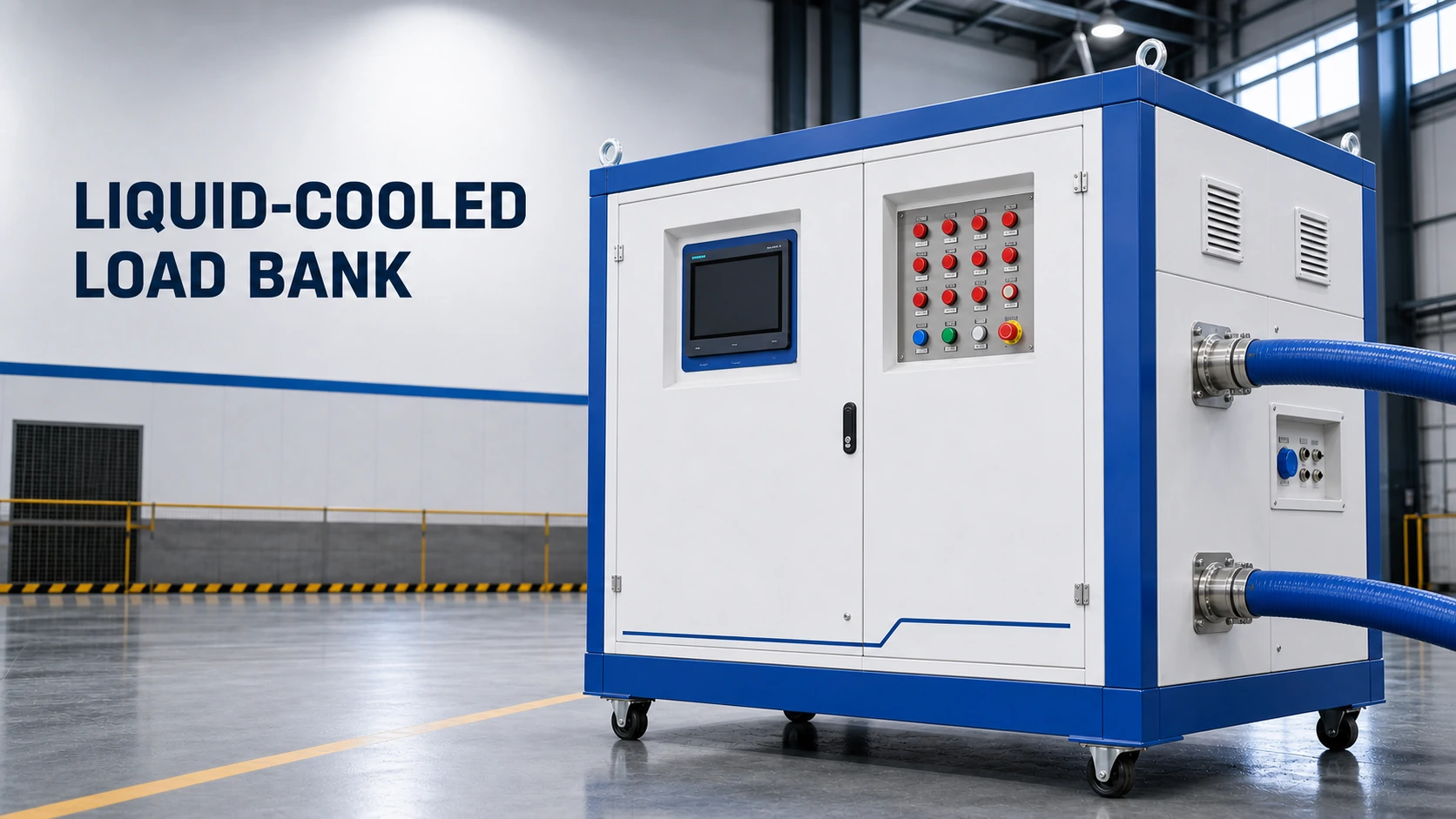
If a liquid-cooled data center is tested only with air-cooled load banks or temporary heaters, the project may pass an electrical test while the cooling loop remains unproven. A properly specified liquid-side test system closes that gap by applying controlled thermal load directly to the coolant circuit.
Keyword role: this is a supporting RFQ guide, not the main product page. For the core product category, review the data center liquid-cooled load bank testing solution. For CDU-specific education, see what a CDU testing load bank is.
Why Liquid-Cooled Data Centers Need Real Commissioning Tests
AI, HPC, and high-density data centers place heavy continuous demand on CDUs, pumps, heat exchangers, manifolds, chillers, and facility cooling loops. Real commissioning tests help confirm that the cooling system can remove heat before expensive IT equipment arrives.
For owners and commissioning agents, the commercial value is direct: fewer late-stage surprises, clearer acceptance records, faster handover, and stronger confidence before energizing production servers.
What the Test System Simulates
The equipment converts electrical power into heat and transfers that heat into water, glycol-water, or another approved coolant loop. It can be connected to a CDU, RCU, test manifold, rack-level loop, or facility loop depending on the project scope.
| Commissioning Target | What the Load Bank Helps Prove |
|---|---|
| CDU / RCU | Cooling capacity, pump response, alarm logic, heat exchanger behavior, and operating stability. |
| Liquid cooling loop | Flow rate, pressure drop, supply temperature, return temperature, and delta-T under staged load. |
| High-density rack zone | Realistic thermal load for AI, GPU, HPC, and liquid-cooled server deployment. |
| FAT / SAT / IST | Documented load steps, alarms, protection actions, and acceptance data for handover. |
Power, Flow, Temperature, and Pressure Control
For serious data center commissioning, kW rating alone is not enough. The test equipment should match the project power, voltage, coolant flow, temperature range, pressure limit, connection interface, and control method.
LBT Power can configure load steps, HMI screens, sensors, and data records around the actual commissioning plan rather than forcing the project to fit a standard catalog unit.
Protection for Safer Data Center Testing
Liquid-side testing must be controlled carefully because it involves electrical load, coolant flow, pipework, sensors, and live commissioning activity. Protection logic should be reviewed before full-load operation.
- Leakage detection and emergency stop
- Low flow protection and pump interlock options
- Overcurrent and short-circuit protection
- Over-temperature protection for resistor and coolant circuit
- High pressure, abnormal pressure drop, and sensor fault alarms
- Door interlock, grounding check, and communication fault alarm when required
Buyer tip: Ask for the protection list, alarm logic, sensor locations, load step table, coolant compatibility, and report format before placing the order. These details affect commissioning quality as much as the headline kW rating.
CDU Interface Matching and Coolant Compatibility
A liquid cooling loop commissioning load bank should be specified around the actual CDU or cooling loop. Important interface details include pipe size, hose type, quick coupling, coolant composition, operating pressure, available flow, target inlet temperature, and whether the unit will connect at rack, row, CDU, or facility-loop level.
LBT Power can support custom mechanical interfaces, control wiring, Modbus RTU/TCP communication, PLC logic, and project-specific FAT documents when the CDU supplier or M&E consultant has special requirements.
Remote Control, Data Logging, and Report Export
Commissioning teams need clear evidence, not just a successful load run. Remote control and data logging make the test easier to operate and easier to approve.
- HMI or PC control for staged load operation
- Remote start/stop, load step selection, and alarm monitoring
- Recording of kW, voltage, current, flow, pressure, inlet temperature, outlet temperature, and delta-T
- Custom Excel or PDF report export for SAT, IST, and handover files
Custom Engineering and Factory Acceptance Testing
Every liquid-cooled data center project is different. LBT Power can build project-specific load bank systems around rack density, CDU type, project voltage, coolant loop design, site connection method, control interface, and delivery schedule.
Factory acceptance testing can include load step verification, protection simulation, sensor calibration check, HMI function test, communication test, leak inspection, and report export demonstration before shipment.
Information to Send Before Requesting a Quote
To receive a practical proposal quickly, send the following details to LBT Power:
- Required load capacity in kW or MW
- Voltage, frequency, phase, and connection point
- CDU model or cooling loop description
- Coolant type, flow rate, inlet temperature, pressure limit, and pipe connection
- Required load steps, test duration, and report format
- Indoor or outdoor installation, available space, and commissioning date
- Remote control, Modbus, HMI, PC software, or data export requirements
Request a Liquid Cooling Loop Commissioning Proposal
Planning CDU testing or liquid cooling loop commissioning? Send LBT Power your capacity, voltage, coolant, flow, pressure, interface, and report requirements. Our engineering team can recommend the right configuration without forcing this RFQ guide to compete with your main product pages.
Send project requirementsFAQ
What is a liquid cooling loop commissioning load bank used for?
It is used to simulate server heat load and transfer it into a coolant loop. Typical use cases include CDU testing, cooling loop validation, AI data center commissioning, FAT, SAT, and IST.
What data should be recorded during liquid-cooled testing?
Typical records include kW, voltage, current, coolant flow rate, inlet temperature, outlet temperature, delta-T, pressure, pressure drop, alarms, protection events, and test time.
Can LBT Power customize the CDU interface?
Yes. LBT Power can customize pipe connections, hose fittings, control wiring, Modbus communication, HMI screens, data logging, report export, and FAT documents around the project requirement.