

Data Center Liquid Cooling Test
What Does a Rack-Mounted Liquid-Cooled Load Bank Test? CDU Test Steps Explained
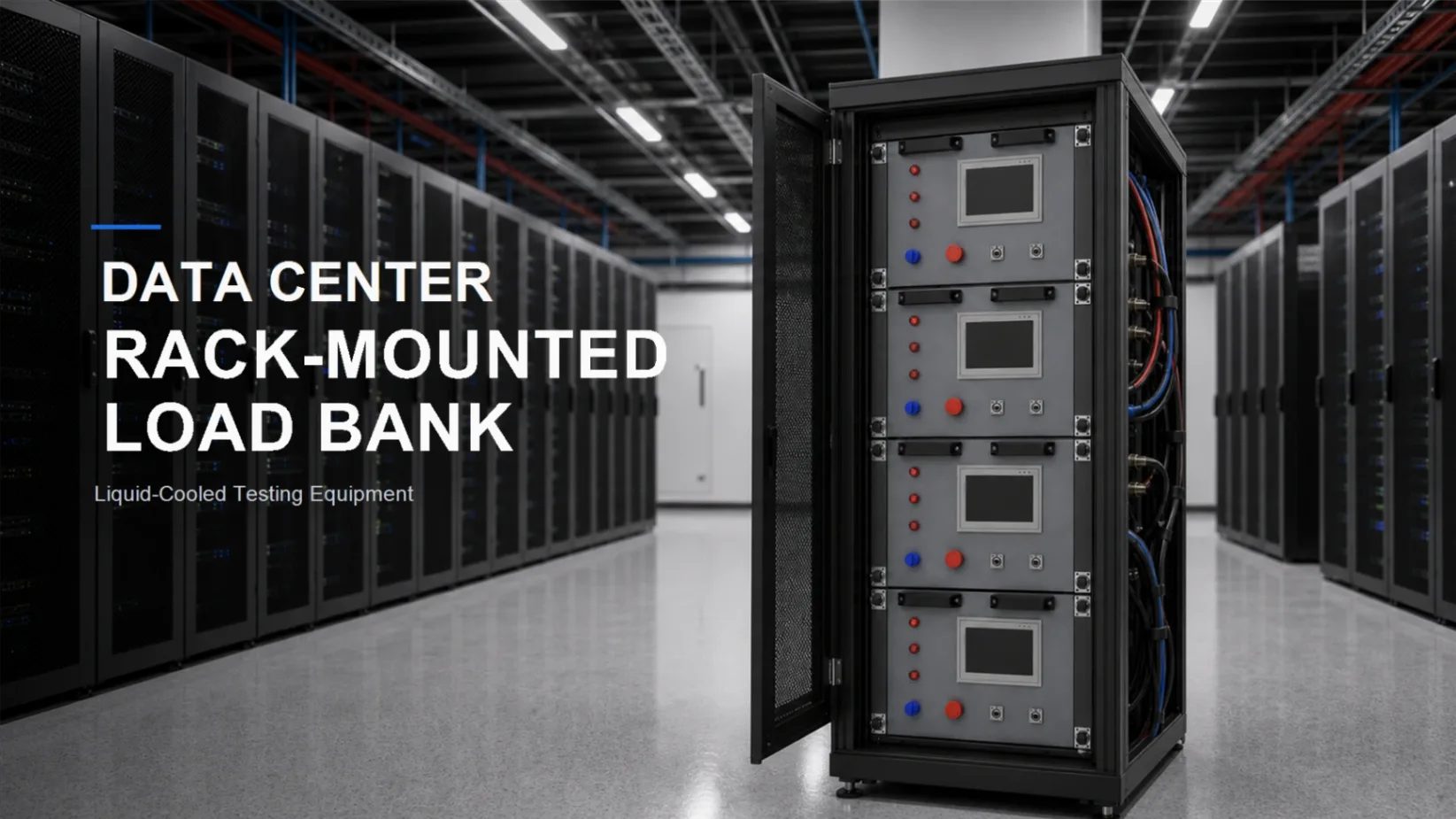
A rack-mounted liquid-cooled load bank works like a controlled dummy server heat load. It is mainly used for CDU testing, but it also helps validate the rack manifold, coolant loop, UQD connectors, power supply, and protection logic before real GPU or CPU servers are installed.
Many buyers first ask a simple question: what does this type of load bank test? The short answer is the CDU. The more useful answer is that it tests the cooling path around the CDU, including the secondary loop, rack manifold, UQD connections, and control response.
Where Is the Load Bank Used?
It is used during data center commissioning, factory acceptance testing, site acceptance testing, and liquid cooling loop validation. In a high-density rack, the load bank is installed like temporary IT hardware and connected to the rack manifold through UQD quick connectors.
The unit draws power from the PDU, converts that electrical power into heat, and transfers the heat into the coolant. This gives the CDU and cooling loop a controllable, repeatable load without exposing expensive servers to first-time water and power tests.
For rack-level projects, see Bidirvolt's rack-level liquid cooling test equipment configuration options.
What Does It Test in the Cooling System?
The load bank is not only a CDU tester. It checks the complete path used by the coolant before real servers are connected.
- CDU: cooling capacity, pump speed, temperature control, alarm response, and redundancy.
- Rack pipework: flow distribution, pressure drop, trapped air, branch balance, and leakage risk.
- Manifold and UQD: connector sealing, supply and return direction, flow stability, and service access.
- Primary cooling source: chiller, cooling tower, or chilled water coordination with the CDU.
- Controls: BMS/ECMS points, Modbus TCP, RS485, PLC logic, alarms, interlocks, and report export.
Why Is CDU Testing Important Before Servers Go Live?
Real AI servers are too costly to use as the first test load. A leak, trapped air, low flow rate, abnormal pressure drop, unstable PID response, wrong breaker capacity, or missing alarm signal can create equipment risk and delay handover.
Liquid-cooled load bank testing helps expose these issues early. It verifies whether the CDU can remove heat at the required load, whether pumps and valves respond quickly, whether redundant CDU switchover works, and whether over-temperature or low-flow protection trips correctly.
In practical commissioning language, the test turns hidden cooling risk into measurable data.
What Are the Basic CDU Test Steps?
- Confirm site parameters: check primary-side cooling water temperature, flow, CDU settings, PDU capacity, breaker rating, and the test plan.
- Check instruments and pipework: confirm temperature sensors, pressure sensors, flow meters, and power meters are within calibration, then perform a preliminary pressure and leak check.
- Connect the load bank: install the 2U or 4U unit in the rack, connect UQD hoses to the supply and return manifolds, and connect power and communication cables.
- Fill and vent the loop: run the CDU pump, fill the secondary loop, remove trapped air, and verify stable coolant level and pressure.
- Check flow and pressure drop: validate branch flow rate and delta-P before high-power heating starts.
- Run cooling capacity testing: step load from 25% to 50%, 75%, and 100%, then hold at 90% or more of design load when required by the commissioning plan.
- Run function and protection tests: simulate low flow, blocked path, rapid load change, CDU redundancy switchover, ATS transfer, and alarm interlocks.
- Run stability testing: keep the load bank at rated load for hours or days when long-duration acceptance data is required.
Which Parameters Should Be Recorded?
A useful commissioning report should show the relationship between heat load, coolant flow, temperature rise, pressure drop, CDU response, and protection events. During cooling capacity tests, teams often record key values every five minutes.
| Parameter | Why It Matters |
|---|---|
| Load power | Confirms whether the test reached the required heat load, such as 90% or 100% rated power. |
| Inlet and outlet temperature | Shows whether the coolant removes heat without exceeding the design temperature range. |
| Delta-T | Helps verify CDU cooling performance and heat transfer stability at each load step. |
| Flow rate | Confirms that the CDU and manifold supply enough coolant to each branch. |
| Pressure drop | Shows whether loop resistance and simulated cold plate resistance are within the expected range. |
| Alarm and trip records | Proves that low-flow, over-temperature, power loss, and redundancy protection logic works. |
Need to Match a Load Bank to Your CDU or Rack Manifold?
Bidirvolt can configure a rack-mounted liquid-cooled load bank for rack height, unit power, voltage, coolant type, UQD interface, flow rate, pressure range, communication protocol, and report export requirements.
For project sizing or RFQ support, send your CDU, rack, and test parameters through the Bidirvolt contact page.
Send Project Parameters