

Bidirvolt builds custom load bank systems that turn power and cooling uncertainty into measurable test data before data centers, generators, UPS systems and critical infrastructure go live.
Load bank control technology
This technology adds fine power regulation to a conventional resistor load bank. It keeps the reliability of high-power resistor loading while allowing the load setting to approach the target test point with much finer resolution.
Conventional load banks usually control power by switching resistor groups. Each resistor group corresponds to a fixed power value, such as 5kW, 10kW, 25kW, or 50kW.
This structure is reliable and suitable for high-power loading, full-load testing, and long-duration operation. However, when a test requires a load point closer to a specific target value, fixed-step control can create load deviation.
The new adjustable power load bank technology adds fine regulation capability to a traditional resistor load structure. Taking a 5kW resistor module as an example, the newly developed power regulation board allows a single 5kW load section to achieve 50W load step resolution.
Assume a liquid-cooled load bank has a total rated capacity of 350kW, with a traditional minimum load step of 5kW.
If the target test load is 126.3kW, a conventional 5kW step system can only set 125kW or 130kW. If the target load is 188.75kW, the closest conventional setting is usually 190kW. If the target load is 242.6kW, the operator can only select 240kW or 245kW.
With 50W fine load regulation, the system can set the load much closer to these target values.
| Target Load | Conventional 5kW Steps | 50W Fine Regulation |
|---|---|---|
| 126.30kW | 125kW / 130kW | 126.30kW |
| 188.75kW | 190kW | 188.75kW |
| 242.60kW | 240kW / 245kW | 242.60kW |
For data center commissioning, CDU testing, UPS testing, power supply burn-in, and FAT/SAT procedures, a load point that is closer to the target value makes test data easier to compare, verify, and document.
This technology uses a combined structure of main load steps plus fine power regulation.
The main load is still handled by resistor modules. For example, 5kW modules provide the base high-power loading capacity. The fine regulation board is used to trim the load near the target power point.
The PLC calculates how many base load modules should be switched on, then controls the fine regulation board to compensate for the remaining power requirement.
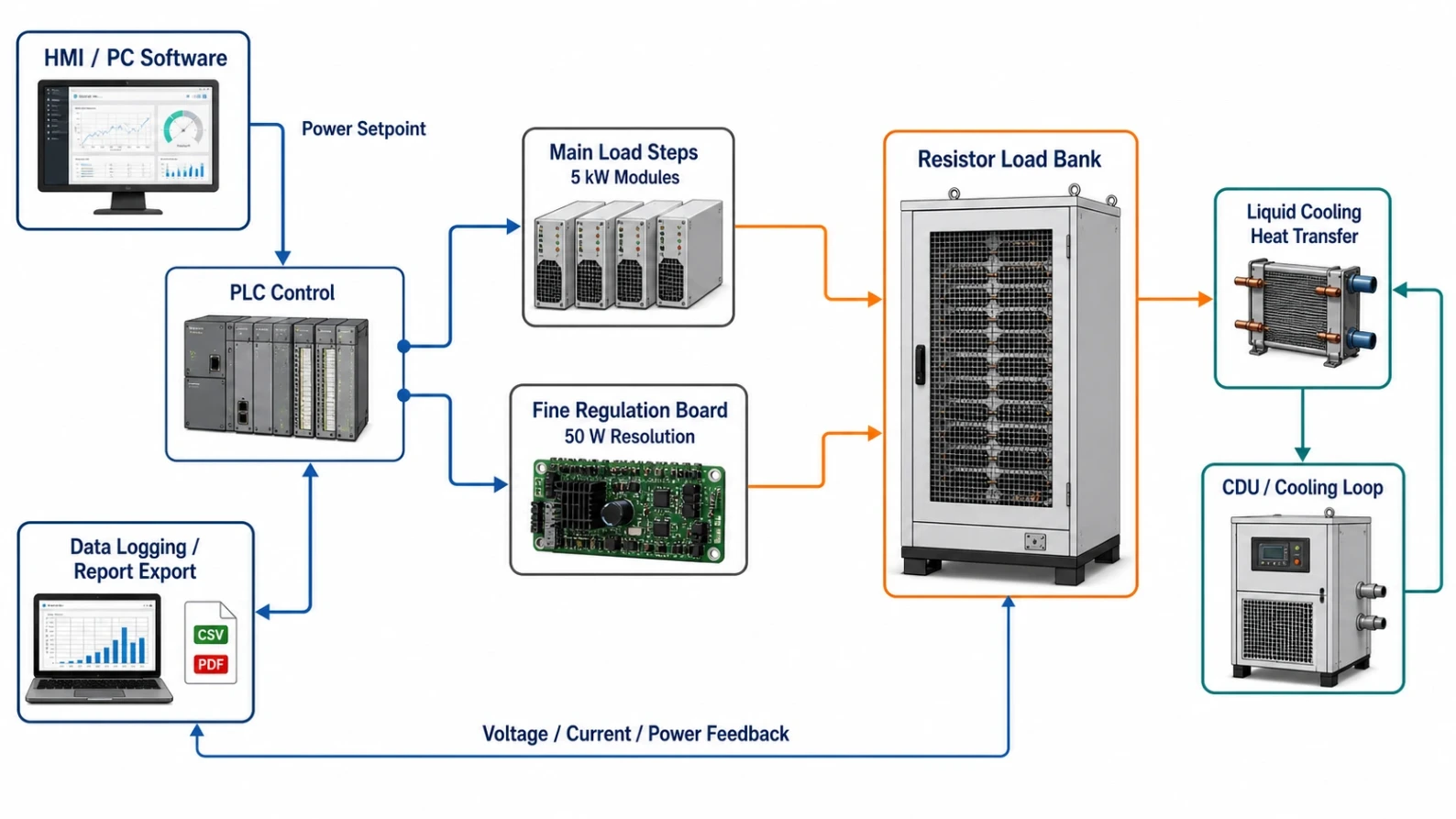
This technology is suitable for test applications that require finer load control.
| Application | Technical Value |
|---|---|
| Data center commissioning | Simulates IT load profiles more closely before servers are installed. |
| CDU liquid cooling testing | Provides finer server heat load simulation for flow, pressure, and temperature response checks. |
| UPS testing | Verifies output behavior at more accurate load ratios. |
| Inverter testing | Helps observe output response under small load changes. |
| Power supply burn-in | Supports long-duration operation at specific load points. |
| FAT / SAT | Provides more detailed test records and acceptance data. |
50W is the load step resolution. It is not the complete system measurement accuracy.
Actual power accuracy is affected by voltage fluctuation, current sampling accuracy, power meter class, resistor temperature coefficient, cooling condition, cable voltage drop, control algorithm, and sensor calibration status.
A precise technical statement should be:
This technology provides 50W load step resolution, allowing the load setting to approach the target test power more closely. Actual power measurement accuracy should be confirmed based on the electrical measurement system and site test conditions.
The new adjustable power load bank technology is an important step from conventional resistor load banks toward controllable load simulation systems.
Using a 350kW liquid-cooled load bank as an example, a traditional 5kW minimum step is sufficient for many standard loading tests. However, when a project requires finer power curve simulation, CDU response verification, UPS load ratio matching, or more detailed FAT/SAT records, 50W load step resolution can significantly improve load control capability.
The core value is not larger capacity. It is more controllable load setting and test data that is closer to the engineering target.
Load step resolution describes the smallest load adjustment the system can set. Power measurement accuracy depends on the electrical measurement circuit, sensors, meter class, calibration, wiring, and site conditions.
The 5kW modules provide stable high-power loading, while the 50W fine regulation board trims the load near the target power point. This combines robust resistor loading with finer control.
No. The 350kW liquid-cooled load bank is used as an example. The same control concept can be applied to other resistor load bank designs when the electrical structure and thermal design support fine regulation.
It is useful in data center commissioning, CDU testing, UPS testing, inverter testing, power supply burn-in, laboratory tests, and FAT/SAT procedures that require a load point close to a defined target value.
For adjustable power load bank design, confirm the rated power, voltage, phase, frequency, minimum load step, fine regulation range, cooling method, control interface, feedback measurement, protection logic, and report format before quotation.