

Load Bank Selection Guide
Essential Technical Parameters for Choosing a Rack-Mounted Liquid-Cooled Load Bank
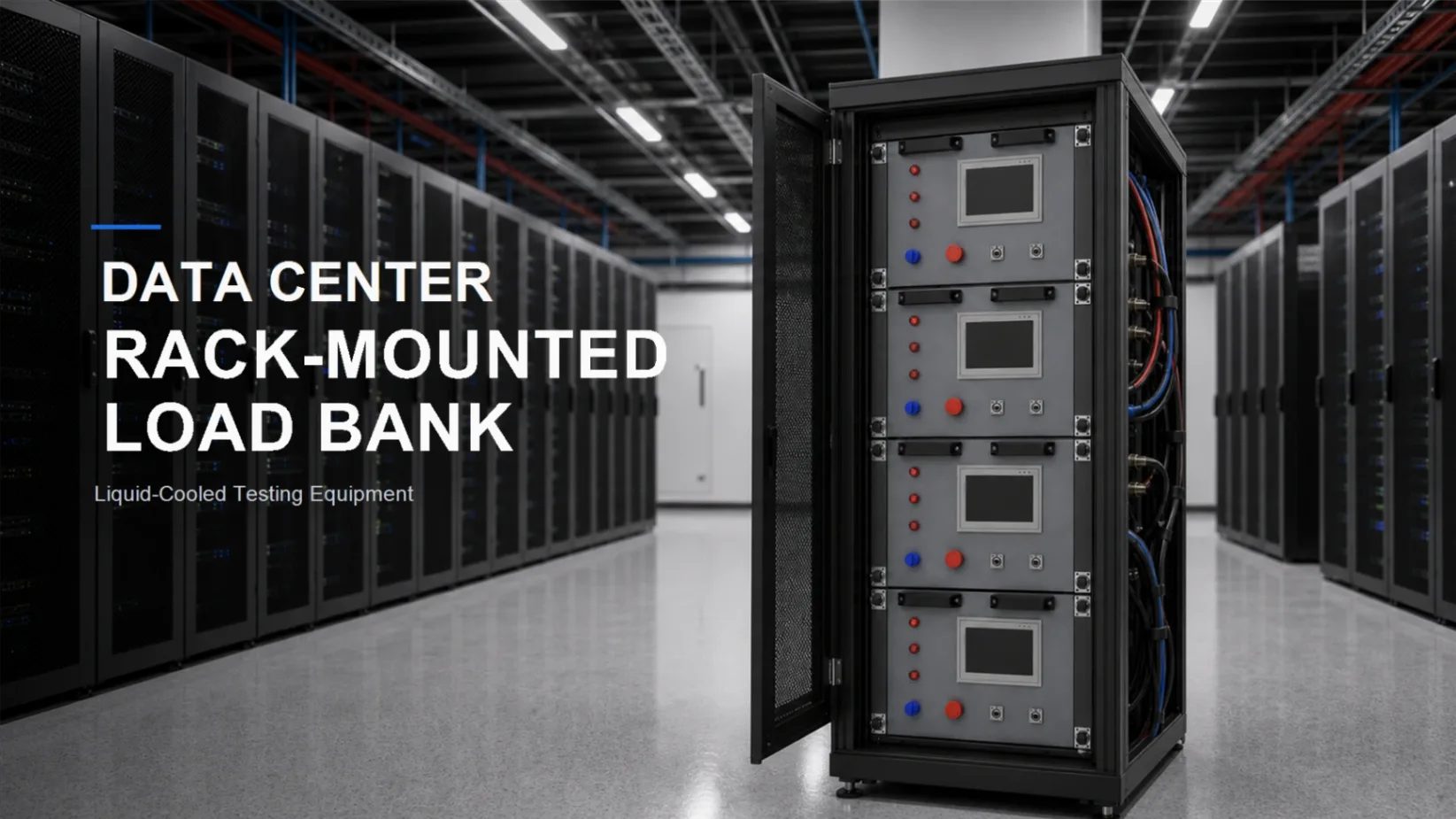
For a first rack-mounted liquid-cooled load bank project, the goal is not only to buy enough kW. The unit must reproduce the electrical heat load and hydraulic behaviour of the server rack closely enough to test the CDU, manifold, PDU, and cooling loop with useful data.
A good liquid cooled load bank specification should answer five practical questions: how much heat must be simulated, what power input is available, what coolant flow and pressure drop are required, whether the unit fits the rack and UQD connectors, and how the test data and safety trips will be handled.
Start With the Server Heat Load You Need to Simulate
The first specification is the rated heat load per unit. Common rack-mounted liquid-cooled load bank modules are designed around 10kW, 20kW, 30kW, or 45kW per 2U to 4U unit, depending on rack density and test purpose.
The selected power should match the expected server or GPU node heat load, not just the total room capacity. For commissioning work, also check the power step resolution. A 1kW or 0.5kW step makes it easier to run 25%, 50%, 75%, and 100% load tests and observe CDU PID response.
Check the Electrical Input and Rack Power Limits
The load bank must match the rack PDU and site power system. Confirm whether the project uses 220V/230V single-phase power or 380V, 400V, 415V, or 480V three-phase power.
For three-phase systems, ask how the heating elements are distributed across phases. Poor phase balance can trigger upstream PDU or switchgear alarms during step loading. Also confirm breaker rating, cable size, inrush behaviour, and whether the PDU can tolerate rapid unloading during fault simulation.
Match Coolant Flow, Pressure Drop, and Cold Plate Simulation
The water-side specification is where many selection mistakes happen. A useful load bank should simulate not only heat, but also the flow resistance of real cold plates. Ask for the flow range, pressure drop curve, and whether the unit has a manual or motorised resistance adjustment valve.
Typical single-unit flow may fall around 5 to 30 L/min, depending on power and target delta-T. The pressure drop might need to be adjustable, for example 30 to 80 kPa at 10 L/min, so the CDU pump head and rack manifold balance can be tested realistically.
Pressure rating also matters. Many projects require a working pressure around 1.0 MPa or higher, with pressure test levels at 1.5 to 2.0 times the working pressure for pipework validation.
Confirm Rack Size, UQD Connectors, and Coolant Compatibility
Most rack-mounted liquid-cooled load banks are built for standard 19-inch racks, with common heights such as 2U, 3U, or 4U. Do not check height alone. Confirm depth, rear clearance, hose bend radius, and whether the unit interferes with the rear manifold or PDU.
The UQD or quick connector must match the manifold exactly, or the supplier must provide approved adapters. Common connector references may include UQD02, UQD04, DN10, or DN15. For commissioning sites, non-drip self-sealing connectors are strongly preferred to reduce leakage when hoses are disconnected.
Coolant compatibility should also be confirmed early. Typical projects may use deionised water, pure water, PG25/PG50 glycol mixture, or another project-specific coolant.
Review Sensors, Communication, and Safety Protection
The load bank should provide enough data for commissioning records, not only local heating. Important sensors include inlet and outlet temperature, inlet and outlet pressure, differential pressure, flow rate, current, voltage, and power.
For accurate heat calculation, temperature accuracy around +/-0.1 to +/-0.2 degrees C is useful. Pressure sensors around +/-0.5% FS and flow meters around +/-1% accuracy are common targets for serious test work.
Control and reporting are equally important. Confirm Modbus RTU, Modbus TCP, RS485, Ethernet, SNMP, or the required site protocol. If the project needs many units, ask whether the software can control one rack, one row, or hundreds of load banks with load scripts, trend curves, and report export.
Safety protection must be hardware-backed. Ask for over-temperature cutoff, dry-run protection, low-flow trip, emergency stop, alarm output, and the response time for unloading the heating elements during a fault.
| Selection Area | What to Confirm | Typical Requirement |
|---|---|---|
| Heat load | Power per unit and load step control | 49kW per unit, 1kW step control |
| Electrical | Voltage, phase, PDU capacity, breaker rating | 380V/400V/480V three-phase |
| Cooling loop | Flow rate, pressure drop, pressure rating | 5-30 L/min, adjustable delta-P, 1.0 MPa working pressure |
| Rack fit | Height, depth, rear clearance, connector type | 2U/4U, matching UQD connector |
| Monitoring | Temperature, flow, pressure, protocol, report export | Modbus TCP or RS485, trend curves, downloadable records |
| Communication | Parallel operation, group control, and multi-unit loading | Supported |
| Mobility and exterior design | Custom lifting eyes, caster wheels, handles, and mechanical layout | Supported |
| Safety | Over-temperature, low-flow, dry-run, emergency trip | Independent protection that unloads the heating circuit quickly |
Need Help Matching Specifications to Your Rack and CDU?
Bidirvolt can configure rack-level liquid cooling test equipment around your rack power, CDU flow, coolant, pressure rating, UQD connector, control protocol, and commissioning report requirements.
For a project-specific recommendation, send your rack power density, CDU flow rate, design delta-T, manifold connector type, coolant, and site voltage through the Bidirvolt contact page.
Send Selection Parameters